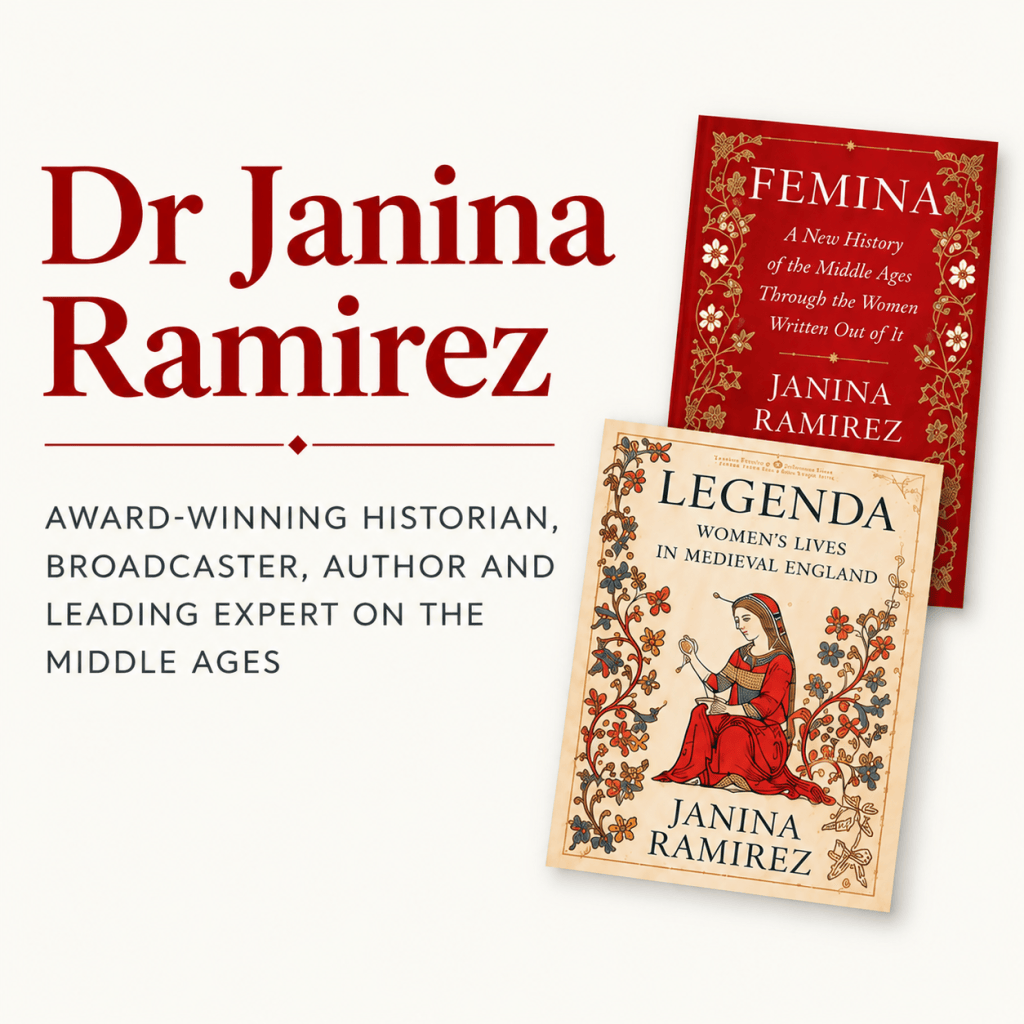
I listened to a lecture on “The people of the past were us, just earlier: How looking with fresh eyes brings History to life.” by Professor Janina Ramirez. This was a perspective of interpreting history that I had not yet come across. Many different topics were included such as the ancient 9,000 year old city called Catalhöyük, women’s rights in medieval history and the vikings. These three topics interested me as I was curious to explore whether the people in the past and their motives were the same as people’s today.
Human creativity began 40,000 years ago through art and music. This was after people did not have to focus on survival every minute of their life as civilised life developed. This inspired the first impressions of what it could be like to lead a fulfilling, intellectual and creative life.
When looking into one of the first human civilisations in the ancient city in Turkey, Catalhöyük, we can explore how it differs from today’s world. In those days there were no roads or pathways. The only way to move was by walking on rooftops of people’s houses. To enter into houses, you would climb from the roof top into them using wooden ladders. I found this particularly revelatory as this is nothing like the world today. The trust that we humans have with each other is much, much lower than 9,000 years ago in ancient Turkey. This is due to many reasons such as capitalism, the divided economy and high crime rates as some people may have hardly any resources compared to others. This differs to Catalhöyük as the city was equal. There were no ruling classes and everyone shared their resources. Another stark difference was that it was mainly female dominated as there was no divide between men and women. This is proven when looking at the skeletons from Catalhöyük. They portrayed that men and women ate equal amounts of protein and their body make-up revealed they did the same labour. There was no preferential distribution of food. This contrasts to the more recent medieval era, which was 1.5 thousand years ago. Archers would have larger and muscular bodies compared to a female body which was much slimmer. This was because they were given priority for eating protein as they had to become strong to fight in battles. Women were seen as delicate, domestic citizens who were nowhere as powerful as men. This highlights how gender equality slowly deteriorated over time. Looking back at the subject of this talk, Catalhöyük became one of the first evolutions of people, farms and settlements. Even though we have drifted away from the once equal life, society today is aiming to get back to the type of gender equality that once existed in Catalhöyük.
In the Medieval period, woman’s rights took a further downfall, especially in literature.
Dr Janina Ramirez captured how much we have lost due to inequality when she stated “Women of the early medieval period are unrecoverable.” Witchcraft and orthodox books were destroyed as well as many books written by females. If women’s books were published, they were often named anonymously. This conveys how much humans have lost as there could have been many authoritative female figures that would have been recognised and influential in today’s society. There were many medieval woman in lots of texts, but their impact, roles and lives had not been mentioned for the world to appreciate. One incredible woman that Dr Janina Ramirez mentioned who is a famed historical figure was Joan of Arc, born in the early 15th century. She has been described and depicted differently over many different generations. Some of her descriptions are that she was patriotic, a populist, democratic, psychotic and manic-depressive. Joan of Arc had commanded an entire nations’ army in the King’s court despite being seen as a disgrace to society due to her apparent witchcraft. She is an influential figure as her life destroyed the rigid rules of medieval society which changed the course of history. At age of thirteen she started having visions from figures named Saint Michael the Archangel, Saint Catherine of Alexandria and Saint Margaret of Antioch who gave her a huge political mission to leave her home, go to the French royal court, remove the blockade placed by the English at Orléans and see the French King Charles VII crowned. Many people thought she was a witch acting under the influence of demons and she was forced to go to trial. Judges found her cross-dressing to be a severe violation of biblical law and church authority. Her trial featured dozens of accusations such as witchcraft and false prophecy. However the main legal reason, given for her execution, was her decision to wear men’s clothing after promising she would stop. At age 19 she was burned repeatedly 3 times in an attempt to erase her from history. Many thought she was out of place as captured in by John Calvin (1509-1564) “A woman’s place is in the home.” Her death is one example of the travesty and injustice against inspirational female figures that changed history.
Lastly, Dr Janina Ramirez discussed the topic of Vikings. Most assumptions we have interpreted about the Vikings are challengeable. To themselves, they were Nords, Swedes, Danes and Icelandics. Our perception of them having horned helmets, being mainly men and having large beards could not have been further from the truth. The idea of wearing horned helmets and muddy, rugged clothes made from leather came from an Opera called Der Ring des Nibelungen performed in 1876 in Germany by Wagner. It was to portray them as dramatic, theatrical and mythic. However this understanding is completely incorrect. In reality, they actually were beautifully decorated and wore clothes made from wool and linen which was designed to survive the harsh Scandinavian climate. To many people, the Vikings have been portrayed as heavily male dominated. However the Vikings worshipped Freyja who was one of the most important goddesses in Norse Mythology and Vikings age. She was the goddess of fertility and vitality. Her influence extends to the fertility of the land, animals and humans. She was worshipped by both farmers and women to protect the lands and healthy offspring. She was the patroness of love and sexuality. She helped in the matters of love or to bless relationships. Freyja was also the goddess of war and death where she shared this role with Odin, the supreme god of the Æsir tribe in Norse mythology. This highlights how she was important in various areas of life. The Vikings inner life matches ours to this day. We share similar fundamental human drives such as the desire for love, success and health. We are just a more modern and complex version of Vikings which has developed and evolved over time.
Overall, from this talk I have learnt how similar we are to our ancestors stretching back thousands of years ago. What I find interesting is that history is not just a ladder, it is cyclical and comes in waves. The equality in gender that the city Catalhöyük had is what many humans fight for and desire once again. The battles that women have to go through to prove themselves to everyone in the Medieval period are battles that many women are constantly facing to this day. The Vikings, who are portrayed as large, strong men with horned helmets are more similar to us than we may have previously thought. I think it is mind blowing how history has managed to repeat itself over and over again during many time periods and how we have not yet managed to find a way to break this ongoing loop. The talk’s title remains vehemently true today, that “The people of the past were us, just earlier.”



Leave a Reply