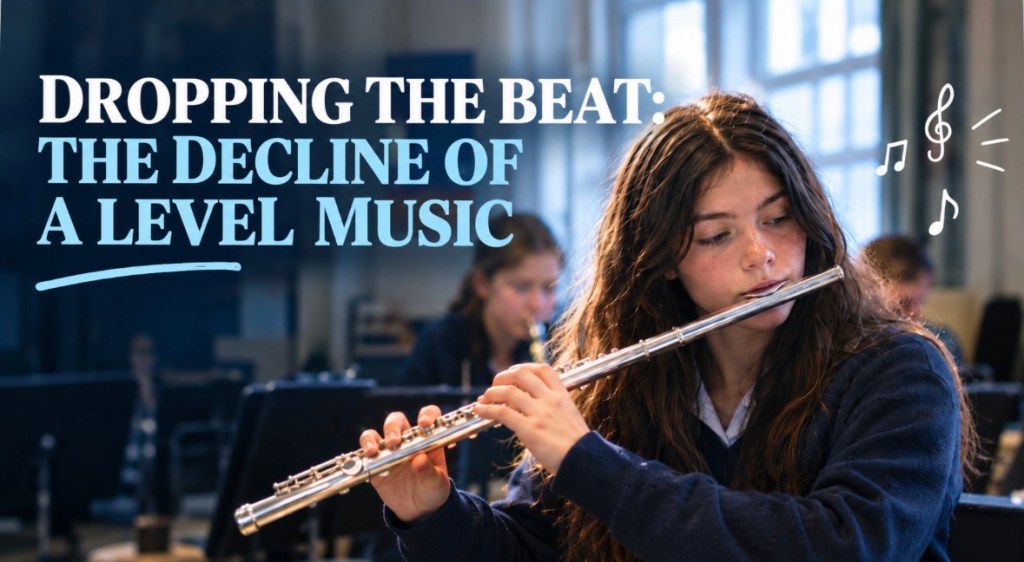
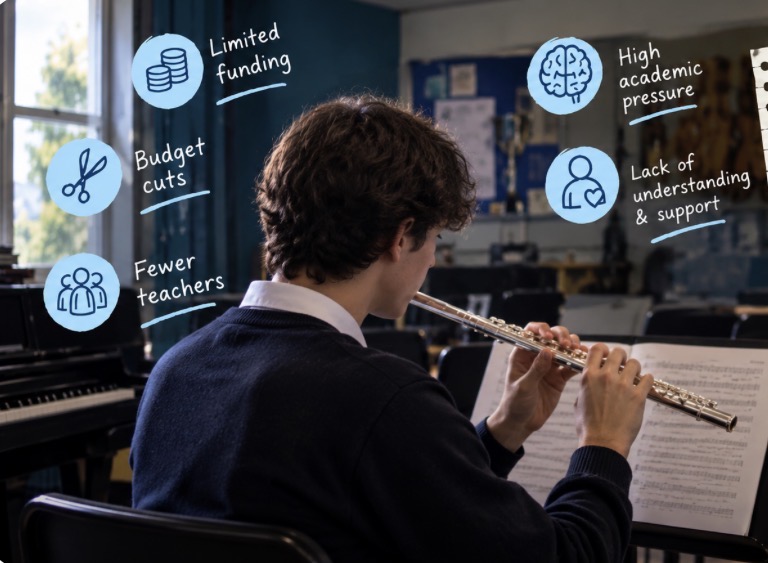
The future of A Level music is bleak. With a lower number of students able to select A Level music each year, due to the lack of teachers, equipment and knowledge, A Level music may not be a possibility in state schools for much longer. Over the past year music entries have fallen by 5.8% across the UK. In 2010, 10,000 students were entering A Level music but now in 2026 it is shockingly at just over half, with only 5,106 entries. The proportion has dropped from 84% of entries from the state sector in 2010, to only 70% today, with the deficit being made up by independent schools. These numbers are concerning for future generations. More and more children each year are missing out on opportunities that were once available for everyone. This is mainly in state schools. State schools have been forced to pull back from teaching music due to tighter budgets, as teachers with advanced music skills are unaffordable in the light of educational budget cuts. Another reason is providing instruments and equipment for students to learn are highly expensive. These reasons risk music becoming just an exclusive privilege for independent school students.
Music engages a diverse network of our brain regions and circuits including: sensory-motor processing, cognitive, memory and emotional components. Learning a musical instrument in childhood has been shown to contribute to improved verbal memory, reading ability and enhanced academic performance. Studies show learning an instrument can help people release stress and anxiety as it allows one to express themselves. It also produces dopamine which has a calming and mood-boosting effect. If less children are given the opportunity to learn a musical instrument, this could become a problem for wider society. There might be a decline of academic achievement and stress management capabilities. Learning an instrument reinforces the spatial-temporal reasoning part of our brain, which is the same cognitive framework used to solve problems in maths, engineering and chess. Without this enhancement, our problem solving skills may decline. Interestingly, a professor from the Royal Academy of Music Junior Department, anecdotally told me that many musicians go onto study Medicine, reflecting the positive impact on academics. Another reason why music is so important for younger generations is that cultures expressed through music would no longer be passed down through families and communities, which would have another negative impact on society.
Most jobs based around music can arguably be AI proof. Music professions that are most likely to survive are based on human creativity, culture and emotions. AI cannot share or portray the human connections we develop through these musical experiences. The feelings while watching our favourite singer or band perform live is something AI could never replace. This is why it is paramount for young children to get the opportunities to study and learn music. However, children from lower income backgrounds face challenges when it comes to music, both financially and socially. With little to no encouragement to study music, these children are less likely to see a possible career path in the industry. This is an unfortunate and disappointing reality facing many children.
Many famous and inspiring artists have realised the impact of these disadvantages, such as Ed Sheeran. To combat this, he appealed to the government in 2025 to commit £250 million of funding for music education. He got 600 signatories from artists such as Elton John, Harry Styles, Coldplay and Stormzy. Sir Keir Starmer was a staunch advocate for music, and when he was the Prime Minister, stated “I want to ensure that music counts towards the curriculum because at the moment it doesn’t really count, therefore many schools don’t do it and therefore many children don’t get the opportunity. We have to change that.”
However, the current government’s priorities lie elsewhere, so it is unlikely his vision will be implemented. Nonetheless, It is incredibly important that each student gets the same opportunities. We need to continue to campaign for the government needs to specifically put funding towards musical education, and realise the benefits for future generations, for real change, or music education for the masses will become obsolete.





Leave a Reply